Uncategorized

Uncategorized

Strategic Asset Disposal: Reducing Overhead via Professional E-Waste Management

For many growing enterprises, the “server room” or “storage closet” eventually becomes a graveyard for legacy hardware. Old laptops, decommissioned servers, and outdated networking gear are often kept “just in case,” but this accumulation of e-waste creates a hidden drain on corporate resources. Strategic IT asset disposal (ITAD) is not simply about getting rid of junk; it is about optimizing your operational overhead and mitigating long-term risk. The Hidden Costs of Legacy Hardware Storage Storing decommissioned electronics may seem cost-free, but the actual overhead is significant: By shifting to a model of professional e-waste management, companies can reclaim their physical space and eliminate these invisible costs. Integrating Disposal into the IT Lifecycle The most efficient organizations treat disposal as the final, critical stage of the IT lifecycle, not an afterthought. A strategic approach involves moving from ad-hoc cleanouts to a scheduled, sustainable IT lifecycle. This ensures that hardware is decommissioned at the point of maximum value and minimum risk. Leveraging sustainable IT lifecycle practices allows a company to synchronize its hardware refreshes with certified disposal schedules, ensuring a seamless transition from old to new without the accumulation of waste. The Competitive Advantage of Professional Disposal Professional disposal removes the logistical burden from your internal IT team, allowing them to focus on high-value infrastructure projects rather than managing waste. From secure transport to certified destruction, a professional partner handles the heavy lifting while providing the necessary audit trails for compliance. Our operational standards are designed to integrate seamlessly with corporate workflows, ensuring minimal disruption to your daily business. Through our commitment to efficiency, we provide the logistics and the certification required to close the loop on your hardware assets. Efficiency is the result of removing friction. An unmanaged pile of e-waste is operational friction. Stop letting legacy hardware occupy your space and your mind. You can optimize your asset disposal today to streamline your operations. For a detailed analysis of your current hardware inventory, we encourage you to request a disposal quote. To stay informed on the latest industry trends in asset recovery, visit our news section or explore our certified disposal services.
Uncategorized

The Hidden Cost of “Cheap” E-Waste Disposal: Legal Risks & Environmental Fines

In the rush to clear out a warehouse or decommission an office, many companies make a fateful decision: they hire the cheapest available collector who promises to take away their electronics for free or at a deep discount. While this may seem like a cost-saving measure in the short term, it often creates a massive, long-term legal liability. In South Africa, the out of sight, out of mind approach to e-waste is no longer a viable business strategy. The Danger of the “Informal” Collector Uncertified collectors rarely have the infrastructure to process e-waste safely. Instead, they often engage in cherry-picking—taking the high-value components and illegally dumping the toxic remains in open fields or municipal bins. Under the National Environmental Management: Waste Act (NEMWA), the legal responsibility for waste does not end when it leaves your premises. The “Duty of Care” principle means that the original producer of the waste can be held liable for pollution caused by their chosen contractor. If your “cheap” provider is caught illegally dumping your corporate assets, your company’s name is the one attached to the manifest. This leads to severe consequences: heavy environmental fines, criminal liability for directors, and catastrophic damage to your brand’s reputation. Verifying Your Partner: The Compliance Checklist To protect your organization, you must move beyond a simple quote and conduct a rigorous compliance check on any e-waste partner. A legitimate, certified recycler will be able to provide: Utilizing transparent tracking technology ensures that you have the evidence required to defend your organization during a government audit. The Value of Certified Disposal Investing in certified recycling services is not an expense; it is an insurance policy. By partnering with a compliant provider, you transfer the operational risk and ensure that your company is contributing to a sustainable future rather than a landfill crisis. Our legal certifications and our commitment to legality provide the peace of mind that your assets are being handled with total transparency. For companies looking to transition away from risky disposal habits, we provide compliant asset disposal that satisfies all national and international standards. The cost of a fine is always higher than the cost of doing it right the first time. Don’t let a third-party contractor jeopardize your corporate standing. Secure your compliance today by partnering with a certified leader in e-waste. For a full review of your current disposal risks, we encourage you to request a compliance audit. Stay informed on the latest legislation by visiting our regulatory update news section.

Uncategorized

Turning E-Waste into ESG Wins: How Circularity Boosts Corporate Reporting

In the modern business landscape, Environmental, Social, and Governance (ESG) metrics are no longer optional “feel-good” additions to an annual report; they are critical indicators of a company’s long-term viability and attractiveness to investors. For organizations with significant IT footprints, electronic waste represents one of the most challenging—yet rewarding—areas for ESG improvement. Transitioning from a linear “take-make-waste” model to a circular approach is the most effective way to turn a liability into a strategic asset. The Role of E-Waste in ESG Scoring Electronic waste is a high-impact category in sustainability reporting due to the presence of hazardous materials and the high energy cost of raw material extraction. When a company simply “discards” hardware, it creates a negative environmental footprint. However, by implementing a circularity-focused strategy, a business can claim positive impact in several key ESG areas: Integrating sustainable technology and innovation into your IT lifecycle allows your organization to quantify these wins with hard data, transforming vague sustainability goals into verifiable KPIs. From Disposal to Resource Recovery The shift to circularity requires a fundamental change in how a company views its “old” hardware. Instead of seeing a decommissioned server as waste, a circular strategy views it as a reservoir of precious metals and reusable components. This is the essence of our commitment to the circular economy: ensuring that the maximum value is extracted from every device while the minimum impact is left on the planet. By partnering with professional e-waste management solutions, companies can move beyond basic recycling and into “upcycling” and “remanufacturing,” which significantly boosts the “E” in their ESG reporting. Implementing a Circular IT Strategy A successful circular strategy is built on three pillars: durable procurement, proactive maintenance, and certified end-of-life recovery. When these elements are aligned, e-waste management stops being a cost center and starts being a driver of corporate reputation. We help companies bridge the gap between corporate ambition and operational reality. You can align your ESG strategy with us to ensure your hardware exit strategy is as sustainable as your business model. For more information on our environmental standards or to request an ESG impact report for your next board meeting, our team is ready to assist. Sustainability is the new gold standard for corporate leadership. Don’t let your e-waste be the weak link in your ESG report. Explore our sustainable industry insights to see how other South African firms are leading the charge in circular electronics, or learn more about our advanced resource recovery techniques.

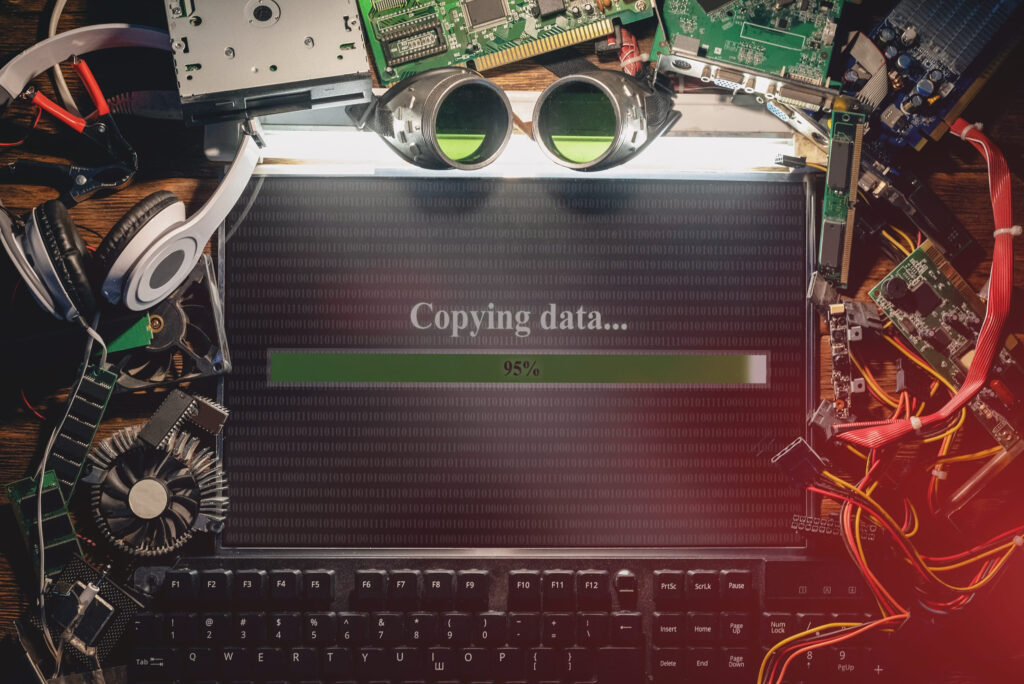
Illegal data copying concept. Flat lay computer and computer parts on the table signifying danger of non POPIA complient E Waste
Uncategorized

Beyond Shredding: Physical E-Waste Destruction & POPIA Compliance

In an era of sophisticated cyber-attacks and stringent privacy laws, the “delete” key is an illusion. For South African businesses, the Protection of Personal Information Act (POPIA) mandates that personal data be destroyed or de-identified as soon as it is no longer necessary for the purpose for which it was collected. However, many organizations make the critical mistake of assuming that factory resets or software wipes are sufficient for old hard drives, servers, and mobile devices. The Fallacy of Software Wiping Software-based data erasure can be effective, but it is prone to human error and software failure. Bad sectors on a hard drive may remain un-wiped, and sophisticated data recovery tools can often retrieve “deleted” information from decommissioned hardware. This creates a massive vulnerability: a discarded laptop or server sold to a third party could become the source of a catastrophic corporate data breach. To truly guarantee that sensitive client data, financial records, and proprietary IP are gone, businesses must move toward secure e-waste disposal services that prioritize physical destruction. Physical Destruction: The Gold Standard of Security Physical destruction—specifically shredding and crushing—renders the storage medium physically impossible to reconstruct. This is the only method that provides 100% certainty and satisfies the strictest interpretations of POPIA. By utilizing advanced destruction technology, eWaste Africa ensures that your decommissioned hardware does not become a legal liability. Integrating Security into your Asset Lifecycle Data security should not be an afterthought at the end of a hardware’s life; it should be integrated into the entire asset lifecycle. A professional disposal strategy includes a detailed inventory of every serial number and a corresponding Certificate of Destruction (CoD). This documentation is your primary defense during a POPIA audit. It proves that the organization took “reasonable technical and organizational measures” to secure personal information. You can learn more about our data security protocols and our commitment to confidentiality to see how we safeguard your corporate reputation. A single lost hard drive can lead to millions in fines and a permanent loss of client trust. Don’t leave your security to chance. Whether you have a single server or a warehouse of legacy hardware, you can book a secure destruction pickup today. For organizations requiring a comprehensive review of their hardware exit strategy, we recommend you request a security audit. For more information on evolving threats, check our data security insights or explore our certified asset disposal workflows.