Uncategorized

Strategic Asset Disposal: Reducing Overhead via Professional E-Waste Management

For many growing enterprises, the “server room” or “storage closet” eventually becomes a graveyard for legacy hardware. Old laptops, decommissioned servers, and outdated networking gear are often kept “just in case,” but this accumulation of e-waste creates a hidden drain on corporate resources. Strategic IT asset disposal (ITAD) is not simply about getting rid of junk; it is about optimizing your operational overhead and mitigating long-term risk. The Hidden Costs of Legacy Hardware Storage Storing decommissioned electronics may seem cost-free, but the actual overhead is significant: By shifting to a model of professional e-waste management, companies can reclaim their physical space and eliminate these invisible costs. Integrating Disposal into the IT Lifecycle The most efficient organizations treat disposal as the final, critical stage of the IT lifecycle, not an afterthought. A strategic approach involves moving from ad-hoc cleanouts to a scheduled, sustainable IT lifecycle. This ensures that hardware is decommissioned at the point of maximum value and minimum risk. Leveraging sustainable IT lifecycle practices allows a company to synchronize its hardware refreshes with certified disposal schedules, ensuring a seamless transition from old to new without the accumulation of waste. The Competitive Advantage of Professional Disposal Professional disposal removes the logistical burden from your internal IT team, allowing them to focus on high-value infrastructure projects rather than managing waste. From secure transport to certified destruction, a professional partner handles the heavy lifting while providing the necessary audit trails for compliance. Our operational standards are designed to integrate seamlessly with corporate workflows, ensuring minimal disruption to your daily business. Through our commitment to efficiency, we provide the logistics and the certification required to close the loop on your hardware assets. Efficiency is the result of removing friction. An unmanaged pile of e-waste is operational friction. Stop letting legacy hardware occupy your space and your mind. You can optimize your asset disposal today to streamline your operations. For a detailed analysis of your current hardware inventory, we encourage you to request a disposal quote. To stay informed on the latest industry trends in asset recovery, visit our news section or explore our certified disposal services.
Uncategorized

The Hidden Cost of “Cheap” E-Waste Disposal: Legal Risks & Environmental Fines

In the rush to clear out a warehouse or decommission an office, many companies make a fateful decision: they hire the cheapest available collector who promises to take away their electronics for free or at a deep discount. While this may seem like a cost-saving measure in the short term, it often creates a massive, long-term legal liability. In South Africa, the out of sight, out of mind approach to e-waste is no longer a viable business strategy. The Danger of the “Informal” Collector Uncertified collectors rarely have the infrastructure to process e-waste safely. Instead, they often engage in cherry-picking—taking the high-value components and illegally dumping the toxic remains in open fields or municipal bins. Under the National Environmental Management: Waste Act (NEMWA), the legal responsibility for waste does not end when it leaves your premises. The “Duty of Care” principle means that the original producer of the waste can be held liable for pollution caused by their chosen contractor. If your “cheap” provider is caught illegally dumping your corporate assets, your company’s name is the one attached to the manifest. This leads to severe consequences: heavy environmental fines, criminal liability for directors, and catastrophic damage to your brand’s reputation. Verifying Your Partner: The Compliance Checklist To protect your organization, you must move beyond a simple quote and conduct a rigorous compliance check on any e-waste partner. A legitimate, certified recycler will be able to provide: Utilizing transparent tracking technology ensures that you have the evidence required to defend your organization during a government audit. The Value of Certified Disposal Investing in certified recycling services is not an expense; it is an insurance policy. By partnering with a compliant provider, you transfer the operational risk and ensure that your company is contributing to a sustainable future rather than a landfill crisis. Our legal certifications and our commitment to legality provide the peace of mind that your assets are being handled with total transparency. For companies looking to transition away from risky disposal habits, we provide compliant asset disposal that satisfies all national and international standards. The cost of a fine is always higher than the cost of doing it right the first time. Don’t let a third-party contractor jeopardize your corporate standing. Secure your compliance today by partnering with a certified leader in e-waste. For a full review of your current disposal risks, we encourage you to request a compliance audit. Stay informed on the latest legislation by visiting our regulatory update news section.

Uncategorized

Turning E-Waste into ESG Wins: How Circularity Boosts Corporate Reporting

In the modern business landscape, Environmental, Social, and Governance (ESG) metrics are no longer optional “feel-good” additions to an annual report; they are critical indicators of a company’s long-term viability and attractiveness to investors. For organizations with significant IT footprints, electronic waste represents one of the most challenging—yet rewarding—areas for ESG improvement. Transitioning from a linear “take-make-waste” model to a circular approach is the most effective way to turn a liability into a strategic asset. The Role of E-Waste in ESG Scoring Electronic waste is a high-impact category in sustainability reporting due to the presence of hazardous materials and the high energy cost of raw material extraction. When a company simply “discards” hardware, it creates a negative environmental footprint. However, by implementing a circularity-focused strategy, a business can claim positive impact in several key ESG areas: Integrating sustainable technology and innovation into your IT lifecycle allows your organization to quantify these wins with hard data, transforming vague sustainability goals into verifiable KPIs. From Disposal to Resource Recovery The shift to circularity requires a fundamental change in how a company views its “old” hardware. Instead of seeing a decommissioned server as waste, a circular strategy views it as a reservoir of precious metals and reusable components. This is the essence of our commitment to the circular economy: ensuring that the maximum value is extracted from every device while the minimum impact is left on the planet. By partnering with professional e-waste management solutions, companies can move beyond basic recycling and into “upcycling” and “remanufacturing,” which significantly boosts the “E” in their ESG reporting. Implementing a Circular IT Strategy A successful circular strategy is built on three pillars: durable procurement, proactive maintenance, and certified end-of-life recovery. When these elements are aligned, e-waste management stops being a cost center and starts being a driver of corporate reputation. We help companies bridge the gap between corporate ambition and operational reality. You can align your ESG strategy with us to ensure your hardware exit strategy is as sustainable as your business model. For more information on our environmental standards or to request an ESG impact report for your next board meeting, our team is ready to assist. Sustainability is the new gold standard for corporate leadership. Don’t let your e-waste be the weak link in your ESG report. Explore our sustainable industry insights to see how other South African firms are leading the charge in circular electronics, or learn more about our advanced resource recovery techniques.

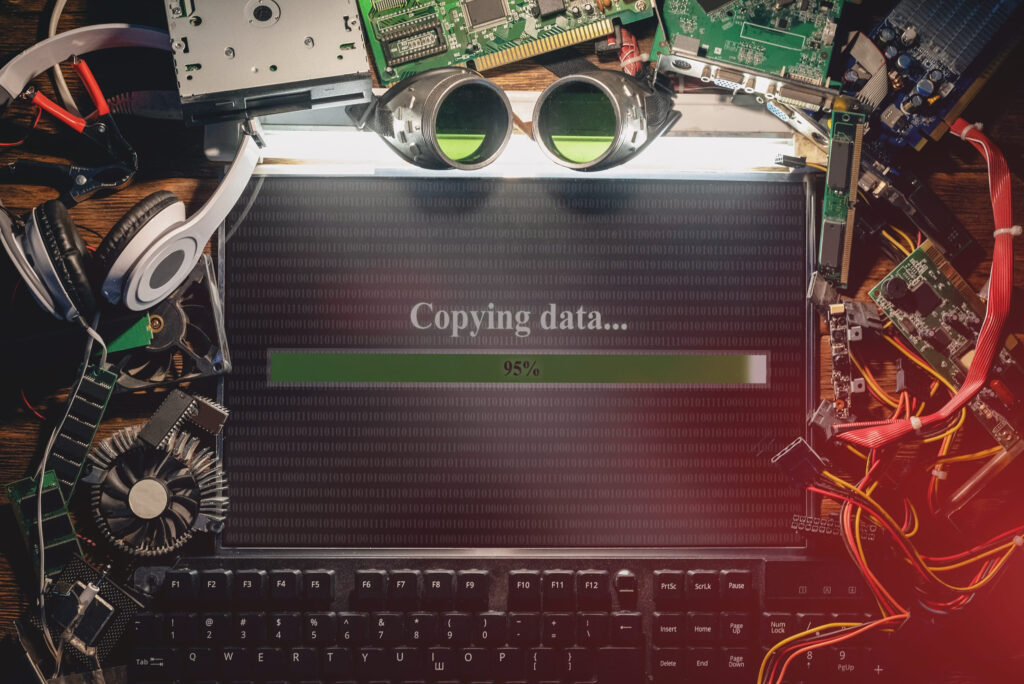
Illegal data copying concept. Flat lay computer and computer parts on the table signifying danger of non POPIA complient E Waste
Uncategorized

Beyond Shredding: Physical E-Waste Destruction & POPIA Compliance

In an era of sophisticated cyber-attacks and stringent privacy laws, the “delete” key is an illusion. For South African businesses, the Protection of Personal Information Act (POPIA) mandates that personal data be destroyed or de-identified as soon as it is no longer necessary for the purpose for which it was collected. However, many organizations make the critical mistake of assuming that factory resets or software wipes are sufficient for old hard drives, servers, and mobile devices. The Fallacy of Software Wiping Software-based data erasure can be effective, but it is prone to human error and software failure. Bad sectors on a hard drive may remain un-wiped, and sophisticated data recovery tools can often retrieve “deleted” information from decommissioned hardware. This creates a massive vulnerability: a discarded laptop or server sold to a third party could become the source of a catastrophic corporate data breach. To truly guarantee that sensitive client data, financial records, and proprietary IP are gone, businesses must move toward secure e-waste disposal services that prioritize physical destruction. Physical Destruction: The Gold Standard of Security Physical destruction—specifically shredding and crushing—renders the storage medium physically impossible to reconstruct. This is the only method that provides 100% certainty and satisfies the strictest interpretations of POPIA. By utilizing advanced destruction technology, eWaste Africa ensures that your decommissioned hardware does not become a legal liability. Integrating Security into your Asset Lifecycle Data security should not be an afterthought at the end of a hardware’s life; it should be integrated into the entire asset lifecycle. A professional disposal strategy includes a detailed inventory of every serial number and a corresponding Certificate of Destruction (CoD). This documentation is your primary defense during a POPIA audit. It proves that the organization took “reasonable technical and organizational measures” to secure personal information. You can learn more about our data security protocols and our commitment to confidentiality to see how we safeguard your corporate reputation. A single lost hard drive can lead to millions in fines and a permanent loss of client trust. Don’t leave your security to chance. Whether you have a single server or a warehouse of legacy hardware, you can book a secure destruction pickup today. For organizations requiring a comprehensive review of their hardware exit strategy, we recommend you request a security audit. For more information on evolving threats, check our data security insights or explore our certified asset disposal workflows.

Collecting electronic waste for recycling
Recycling, Solar Panel Recycling

The 2026 Guide to EPR Compliance for Electronics Producers in South Africa

For producers and importers of electrical and electronic equipment (EEE) in South Africa, the regulatory landscape has shifted from “voluntary” to “mandatory.” Under the National Environmental Management: Waste Act (NEMWA), Extended Producer Responsibility (EPR) is now a cornerstone of corporate legality. As we move into 2026, the focus has intensified on measurable collection targets and transparent reporting, leaving no room for administrative oversight. What is EPR and Why Does it Matter Now? Extended Producer Responsibility (EPR) shifts the physical and financial burden of a product’s end-of-life management from the municipality to the producer. In simpler terms, if you put electronics into the South African market, you are legally responsible for ensuring they do not end up in a landfill. Non-compliance is no longer just an environmental concern—it is a significant financial and legal risk. Failure to meet annual collection targets or provide accurate data to the Department of Forestry, Fisheries and the Environment (DFFE) can result in heavy penalties and reputational damage. Integrating professional e-waste services and solutions into your supply chain is the only way to ensure these obligations are met. The 2026 Compliance Checklist To maintain a compliant status, producers must focus on three critical pillars of the EPR framework: Leveraging sustainable technology and innovation allows companies to track these metrics in real-time, turning a regulatory burden into a streamlined operational process. Moving Beyond Compliance to Circularity While the immediate goal is to avoid fines, the most successful companies are using EPR as a catalyst for a circular economy. By designing for durability and implementing robust “take-back” schemes, brands can recapture valuable materials and strengthen customer loyalty. At eWaste Africa, our approach to circular economy focuses on maximizing resource recovery while minimizing environmental footprints. We help producers navigate the complexities of the law by providing certified e-waste recycling that satisfies all government audits. Compliance is not a one-time event; it is a continuous operational requirement. If you are unsure of your current standing or need to optimize your 2026 reporting, we recommend you speak with an e-waste compliance expert today. For a deeper dive into our processes, feel free to explore our certification and standards or request an EPR audit to identify gaps in your current strategy. Stay updated on the shifting legal landscape by visiting our latest e-waste industry news section.

26 Million Panels
Recycling, Solar Panel Recycling

26 Million Panels: Green Energy’s Grey Problem

South Africa’s renewable energy boom is an incredible success story. Driven by massive private investment, commercial rooftops, and the utility-scale solar farms of the REIPPPP, we have successfully deployed an estimated 26 million solar panels nationwide. We are successfully harnessing the sun to solve our immediate energy crisis. But as we celebrate this green energy milestone, we need to talk about the looming “grey” problem. What happens to 26 million panels when they reach the end of their operational lifespan? The Landfill Ban  The most critical factor for solar farm operators, EPCs, and commercial property owners to understand is the legal classification of these panels. Under South African environmental law, all solar panels are classified as electronic waste. This means they are strictly banned from all landfills. Disposing of end-of-life solar panels in general waste or burying them is not just a massive loss of finite resources; it is a direct violation of environmental regulations. As the regulatory landscape tightens, the “Duty of Care” principle ensures that the producer retains legal liability for this waste from cradle to grave. Processing and Partnerships You need a legally compliant, traceable solution for your end-of-life modules. With our established expertise in complex waste management, EWaste Africa is fully equipped to handle this growing waste stream today. We currently process thin-film, monocrystalline, and polycrystalline silicon-based PV modules at our facilities, safely dismantling them to recover valuable materials such as aluminium frames, copper wiring, and glass. We are actively working on innovative ways to beneficiate these materials, improving the purities of our end products to continually increase their value and circularity. We also recognise that the solar industry utilises a variety of technologies. For other specialised module chemistries, we work closely with a vetted network of expert partners to ensure that every panel type is managed safely and compliantly. Generating Carbon Offsets Through Recycling  Diverting end-of-life solar panels from landfills doesn’t just ensure legal compliance; it is a powerful tool for combating climate change. Recycling recovers embedded materials, drastically reducing the need for the energy-intensive mining, extraction, and refining of virgin resources like aluminium and silicon. By keeping these materials in the circular economy, we avoid the significant greenhouse gas emissions associated with manufacturing new panels from scratch. This diversion and recovery process translates directly into carbon offsets, helping your business lower its carbon footprint and actively meet its ESG (Environmental, Social, and Governance) targets. True Circularity: Paving the Future We do not just recycle; we actively manufacture circular solutions. The glass recovered from the solar panels we process is repurposed and used to manufacture our interlocking eco-pavers. These pavers consist of approximately 40 percent post-consumer recycled glass, significantly reducing the need for raw, finite materials like sand. Furthermore, these eco-pavers have been awarded the GreenTag™ GBCSA LCARate Bronze certification. This independent rating is accepted by the Green Building Council of South Africa (GBCSA) and can be used in their calculations for awarding Green Star ratings to commercial buildings. By choosing EWaste Africa for your module recycling, your end-of-life solar panels could quite literally pave the way for greener infrastructure and green building credits. Your end-of-life liability is already ticking. Partner with a Technical Authority that can manage your solar waste legally, sustainably, and innovatively. Contact us today to discuss your PV module recycling needs.

Are you certain your e-waste recycler is legally compliant?
Legal compliance, Recycling

Is Your Recycler Legally Compliant? The Critical Importance of Due Diligence

In the current economic climate, procurement departments and sustainability managers are under immense pressure to optimise costs. When a service provider offers to collect your electronic waste at a significantly lower rate, or even for free, it often feels like an immediate win for the bottom line. However, cost should never be the only factor in your decision-making. It is vital to look beyond the price tag and strictly verify that your service provider has the requisite registrations and licenses to handle your waste safely. If they do not, the liability remains with you. The Necessity of Due Diligence Legitimate e-waste recycling is a complex industrial process with high operational costs. To ensure your company is not exposed to risk, verify that your recycler is fully compliant with South African law. Do not hesitate to ask for proof before handing over your equipment. A compliant recycler must be able to produce a Hazardous Waste Management License and proof of valid registration for waste storage. You should also check that their logistics team holds the necessary licenses and specialised training for transporting dangerous goods on public roads. Beyond the basic legal requirements, voluntary certifications serve as a robust verification mechanism. Accreditation in ISO 9001 (Quality), ISO 14001 (Environmental Management), and ISO 45001 (Occupational Health and Safety) confirms that the waste sent to the recycler is being handled in a safe, environmentally responsible, and legally compliant manner. These standards ensure that your environmental footprint is minimised and that workers are protected from toxic exposure. The Regulatory Crackdown is Here Verification is more important now than ever because the regulatory landscape in South Africa is tightening significantly. The Department of Forestry, Fisheries, and the Environment (DFFE) has signalled a strong push to enforce the National Environmental Management Act (NEMA) more rigorously. This is not just a warning; it is actively happening. A recent report highlights that the government is launching a major crackdown on non-compliance. You can read the full details on the increased enforcement measures here: Major crackdown on companies and municipalities in South Africa with possible jail time for leaders. There are more inspections planned for the coming year, with a specific focus on waste management facilities and the producers who use them. This pressure is not limited to the national government. Individual municipalities are also looking at how they can enforce their local bylaws more stringently to curb illegal dumping and mismanagement within their borders. Personal Liability for Directors The risks of ignoring these regulations are personal. The NEMA “Duty of Care” principle establishes that liability for waste is cradle-to-grave. This means that even after the waste leaves your premises, your company remains responsible for it until it is responsibly recycled or disposed of. If your waste is found dumped illegally, your company is responsible for the cleanup and the fines. Furthermore, authorities have indicated a move toward holding leadership personally accountable. As noted in the article linked above, we are seeing a shift where directors and CEOs can face criminal charges and even jail time for serious environmental offences committed by their companies. Ignorance of your service provider’s practices is no longer a valid defence. Partner with a Compliant Recycler Don’t leave your compliance to chance or risk your reputation on an unverified vendor. Partner with a Technical Authority like EWaste Africa to ensure your electronic waste is recycled responsibly. We hold ISO 9001, 14001, and 45001 accreditations, offering you the peace of mind that your liabilities are managed correctly and your waste is processed in accordance with the highest global standards. Contact us today to discuss your e-waste recycling needs.

Recycling

New Year, Same Planet? Try the 1-2-3 Rule

The festive lights have been packed away, the “Dezemba” vibe has faded, and the cold reality of “Janu-worry” has set in. For many South Africans, this is the month where budgets are tight, and the regret of December spending lingers. It is the perfect time to rethink our relationship with the things we own. Every January, we see a flood of “New Year, New Me” messages urging us to buy more organisation tools, more gym gear, or more gadgets to optimise our lives. But at EWaste Africa, we propose a different approach for 2026. It is a simple mental filter we call the 1-2-3 Rule. It is not just about being “green.” It is about thermodynamics, economics, and common sense. 1. Reuse (The Smartest Economic Choice) The most sustainable device is the one you already own. In a consumer culture obsessed with the “latest release,” we often forget that a two-year-old laptop or phone is still a powerful piece of engineering. From a scientific perspective, the energy and resources required to manufacture a new device are astronomical compared to the energy used to maintain an existing one. If you strictly need to buy tech this month, consider high-quality refurbished equipment. It costs significantly less than buying new, which helps your budget, and it prevents the carbon emissions associated with manufacturing new chips and screens. 2. Repair (Fighting Entropy) When something breaks, our instinct is often to replace it. This is a relatively new human behaviour, driven by the convenience of cheap manufacturing. However, repair is an act of resistance against waste. Whether it is a cracked screen or a tired battery, fixing a device extends its lifespan and keeps it out of the landfill. It is almost always cheaper to replace a battery than to buy a new phone. By choosing to repair, you are keeping materials in circulation at their highest value state. 3. Recycle (The Final Resort) Recycling is often sold as the first solution, but it should actually be the last. We should only recycle a device once it can no longer be reused or repaired. When that time comes, it is critical to do it right. Dumping electronics in a general bin is not just wasteful; it is dangerous. As we discussed in December, decaying batteries release hazardous chemicals and pose fire risks. How to find a drop-off point. When your device is truly at the end of its life for you, and you want to ensure it enters a legitimate recycling stream, we have made it easy for you. Google Maps: Simply open Google Maps and search for “EWaste Africa drop-off” to find the nearest bin. Website: You can also use the interactive map on our website to locate a secure container: https://ewasteafrica.net/services-and-solutions/ The 2026 Mindset This year, before you tap your card to buy something new, pause and apply the 1-2-3 Rule. Can I reuse what I have? Can I repair it if it is broken? And if I must get rid of it, will I recycle it responsibly? Your wallet will thank you, and so will the planet.